The packaging trends in the dairy segment impacting on your transport packaging
The dairy sector is undergoing profound change: sustainable packaging is no longer optional but mandatory – driven by regulatory requirements such as the PPWR and rising consumer expectations. While bio-based and fibre-based primary packaging is increasingly replacing conventional plastics, polymer-based transport packaging remains indispensable, as it must ensure stability and safety. Modern blown films with a high PCR content significantly reduce material usage and CO₂ emissions while simultaneously increasing transport safety. In addition, optimised wrapping processes enable savings of up to 30% and enhance efficiency along the entire cold chain. At the same time, convenience trends, personalisation, and digital packaging functions are driving the further development of the market.
Sustainability as a requirement
The expectations of consumers and regulators have made sustainable packaging solutions a central criterion in the dairy industry. According to a study by the industry association PMMI, recyclability, material reduction, the use of post-consumer recycled material (PCR), and lightweight design are the key levers with which dairy producers can make their packaging more sustainable. Bio-based or compostable materials, as well as fibre-based packaging, are increasingly replacing conventional plastic packaging.
For transport packaging, however, the choice of materials is more limited, as performance and safety are the primary considerations. Polymer-based solutions therefore remain the dominant choice. The new EU Packaging Regulation (PPWR) reflects this: specific requirements are defined for plastic transport packaging such as films and strapping. Under the PPWR, films used for pallet overwrapping must contain at least 35% PCR from 2030 onwards, and the films must also be fully recyclable. The aim is to reduce the CO₂ footprint and keep raw materials in circulation by minimising packaging and applying lightweighting principles.
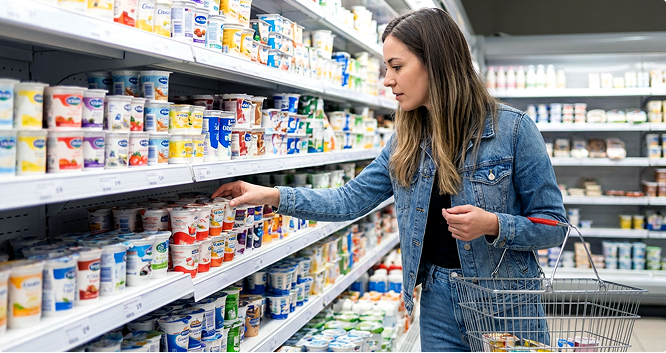
In the dairy segment, rely on state-of-the-art transport packaging with high-quality blown film from DUO PLAST.
High-quality blown films make a significant contribution to reducing material usage, while at the same time increasing transport safety. In many cases, they already consist of recycled plastics and are fully recyclable. In addition, the precise coordination of film thickness, pre-stretch, and wrapping technique is of central importance: optimised processes not only reduce material and energy costs but also increase efficiency along the entire cooling and supply chain.
Sustainability in the dairy segment today therefore means not only ecological responsibility, but combines environmental friendliness, economic efficiency, and process optimisation – a development that is shaping all areas of dairy logistics.
Another key lever is the optimal use of wrapping machines. With the right balance of film thickness and pre-stretch, film costs per pallet can be reduced by up to 30%. In addition, correctly setting the machine parameters saves energy and prevents film breakage.
Convenience, personalisation, and digital solutions
Consumers are looking for convenient and individually designed products. Single-serve portions, reclosable pouches, and stackable designs offer maximum usability on the go. At the same time, smart packaging is making its way into the dairy sector: freshness indicators and QR codes provide information on shelf life, origin, or sustainability data. Personalised labels or packaging for niche markets (e.g. lactose-free or probiotic products) strengthen brand loyalty.
Technologies for shelf-life extension
To reduce the perishability of dairy products, modified atmosphere packaging (MAP), vacuum packaging, and high-barrier laminate films are increasingly being used. For shelf-stable products such as UHT milk or long-life yoghurt varieties, aseptic packaging is employed, which does not require refrigeration and therefore saves energy.
Implications for the load unit
New materials and packaging formats alter the friction coefficients, stiffness, and geometries of load units. Thin-walled, fibre-based, or PCR-containing packaging is generally less stable and requires particularly gentle wrapping. Companies should closely accompany pilot projects with sustainable primary packaging and validate wrapping processes in order to ensure safe pallets.
At the same time, dairy companies have the opportunity to improve their overall sustainability score through more sustainable transport packaging.
Those who rely on PPWR-compliant transport packaging solutions today do not risk jeopardising the sensitive new developments in primary packaging. For every transport packaging solution, the decisive factor is that it brings the load unit safely to its destination.
Conclusion:
- Sustainable packaging solutions are becoming mandatory n the dairy segment and must combine material efficiency, safety, and performance.
- New packaging materials are changing the requirements or the load unit and require precise, validated wrapping processes.
- Modern blown films with a PCR content increase ransport safety and reduce material and energy costs along the cold chain.
- Dairies that adopt PPWR-compliant transport packaging and optimised processes at an early stage reduce risks, costs, and CO₂ emissions.
1) EU-Commission – Packaging and Packaging Waste Regulation (PPWR)
Official description of the new EU requirements for packaging: recyclability, recycled content, material reduction, bans, design specifications.
https://environment.ec.europa.eu/topics/waste-and-recycling/packaging-waste_en
(2) ERP Recycling (2025) – PPWR Whitepaper
Detailed analysis of the PPWR: regulatory timelines, PCR quotas by plastic type, impacts on transport packaging.
https://erp-recycling.org/wp-content/uploads/2025/05/PPWR-Packaging-and-Packaging-Waste-Regulation-EN-final.pdf
(3) Plastics Recyclers Europe (2024)
Market data on PCR availability, price developments, challenges in food-grade recyclates (PET, PE, PP).
https://www.plasticsrecyclers.eu
(4) IK Plastics Packaging Industry Association (2023)
Pressemitteilung zur Herausforderung bei PCR-Quote für Lebensmittelverpackungen: „Nicht genügend lebensmitteltaugliches Rezyklat vorhanden“.
https://kunststoffverpackungen.de
(5) McKinsey & Company (2025) – Global Packaging Survey
Global consumer survey: relevance of sustainability, convenience, recyclability, and smart features in packaging.
https://www.mckinsey.com/industries/packaging-and-paper/our-insights/sustainability-in-packaging-2025-inside-the-minds-of-global-consumers
(6) McKinsey & Company (2025) – The push for sustainability packaging is real—and complicated
https://www.mckinsey.com/industries/energy-and-materials/our-insights/blog/the-push-for-sustainability-packaging-is-real-and-complicated