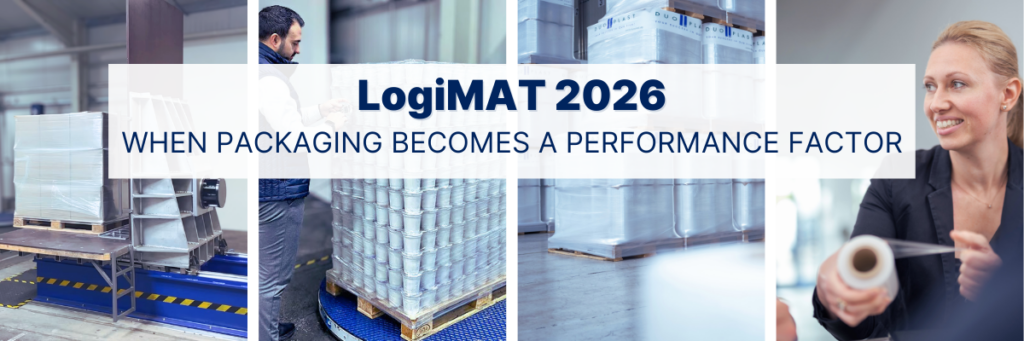
Sustainable films instead of reusable packaging mandates: Why sustainable single-use packagimg is the better choice
PPWR Article 29, environmentally friendly films, reusable packaging, EU Packaging Regulation
The EU Packaging and Packaging Waste Regulation (PPWR) presents fundamental challenges for the packaging industry. Article 29 (1–3), in particular, stipulates that transport packaging currently using stretch film, stretch hoods, shrink hoods, and strapping bands must be reusable by 2030—with reuse quotas of up to 100%.
What may seem sustainable at first glance, however, proves—upon closer examination—to be inefficient, costly, and ecologically counterproductive.
Scientifically confirmed: Single-use can be more environmentally sustainable!
DUO PLAST, together with the European Plastics Converters association (EuPC)¹, supported two independent studies that objectively assessed the environmental impact of single-use versus reusable packaging.
One of these, a life cycle assessment (LCA) conducted by IFEU Heidelberg in accordance with ISO 14040/14044², examined eight key industries and compared packaging solutions such as stretch films, stretch hoods, and shrink packaging with reusable systems like foldable plastic crates and cardboard alternatives. Kunststoffboxen und Kartonlösungen.

What sets this study apart: The LCA analysis is based on a precise calculation of the required packaging material, taking into account load unit stability in accordance with EUMOS 40509. This is the only way to ensure a realistic and meaningful assessment.
Previous studies—such as those evaluating paper-based stretch solutions—neglected this critical aspect, leading to unrealistic and misleading results.
The result of the IFEU study is clear:
- Single-use packaging is ecologically superior in all scenarios.
- CO₂ emissions from reusable systems can be up to 1,700% higher, depending on the specific use case.
- The main drivers are the higher weight of reusable transport solutions, empty return logistics, and resource-intensive cleaning processes.
The implementation of mandatory reuse would lead to significant negative impacts:
- Additional CO₂ emissions in the double-digit million-tonne range – and that is a conservative estimate.
- Offsetting this would require reforestation of an area equivalent to several German federal states.
- There is no existing EU-wide “open pool” system for reusable boxes – and it cannot be implemented by 2030.
- Companies would face enormous burdens due to parallel packaging systems.
- Disproportionate administrative effort required to categorise each pallet by transport route (e.g. domestic, intra-company, export, etc.).
DUO EARTH: The sustainable packaging solution for the future.
DUO EARTH films are made of up to 65% post-consumer recycled material, are fully recyclable, and are already integrated into a functioning circular system.
At the customer’s goods-in department, they are collected by material type, sold to recyclers, and processed into high-quality granulate, which is then used to produce new DUO EARTH films.


Economic reality: cannot be ignored
The RDC study (3), also commissioned, estimates the additional economic costs of a mandatory reusable packaging system at up to €4.9 billion per year.
Small and medium-sized enterprises (SMEs) and export-oriented companies would be particularly affected, as they would be required to maintain two parallel packaging systems.
The result: competitive disadvantages compared to non-EU countries and increased administrative burdens.
A fatal step toward the deindustrialisation of the EU.
If you are interested in the studies, feel free to contact us at any time. We’ll be happy to advise you.
DUO PLAST is your reliable partner for all matters related to transport packaging.
The advantages of stretch film and stretch hoods at a glance:
- Secure load stability with just a few hundred grams of material
- 100% recyclable with high material value when returned to established closed-loop systems
- Compatible with all existing end-of-line packaging machines
- No return transport or cleaning required
- Minimises empty space on trucks compared to rigid reusable containers
- No additional investment needed for new logistics systems
- Simple and efficient to use – regardless of the transport destination
- No EU-wide open pool system for reusable transport boxes currently exists – unlike the well-established EPAL EURO pallet system
- Even the proven EURO pallet system would not work without stretch film and strapping
- The vast majority of goods transported on the more than 500 million EURO pallets in circulation⁴ are securely stabilised using stretch film and/or straps
- Reusable solutions can be advantageous in certain logistics sectors – and where that’s the case, they have already been widely implemented, without the need for legal mandates
Regulatory adjustments are possible
We must keep in mind that the current requirement in Article 29 of the PPWR was increased—apparently unintentionally—from 10% to 40% and even 100% for transport within a single country or between affiliated companies within the EU, shortly before the final version was completed (5).
Article 29 (18) of the PPWR provides for exemptions for certain packaging types, where justified by ecological or economic reasons. This clearly applies to stretch film, stretch hoods, shrink hoods, and strapping.
The European Commission has been tasked with evaluating the basis for exempting these packaging types from the reuse obligation. DUO PLAST is actively engaged in this process, contributing technical expertise and robust data.
The European Commission has already agreed to remove the 100% reuse quota for intra-national transport and transport between affiliated companies within the EU (Article 29 (1) and (2)).
Now, it is essential to highlight that even a 40% reuse quota under Article 29 (1) would have severe consequences—and must also be considered for removal (6)(7).
Conclusion:
(1) https://www.plasticsconverters.eu
(2) IFEU Heidelberg LCA (ISO 14040: 2006; ISO 14044: 2006) Comparative life cycle assessment of various singleuse and reuse transport packaging. Analysis of single-use stretch wrap, stretch hood and shrink hood in comparison to single-use paper stretch, single-use and reuse cardboard boxes, reuse sleeves and reuse plastic boxes according ISO standards on), / 30-7822 / commissioned by EUPC / Heidelberg, April 14 the 2025 by Benedikt Kauertz, Andrea Drescher ; critical review by: Hélène Cruypenninck (chair), seven-c, France; Nicolas Cayé, GVM, Germany; Miguel Brandão, KTH Royal Institute of Technology, Sweden; Ruben Aldaco Garcia, Cantabria University, Spain
(3) Economic impact of switching to reusable options for pallet wrapping – avilabel at DUO PLAST
(4) https://www.epal-pallets.org/eu-de/
(5) https://abfallr.lexxion.eu/article/ABFALLR/2024/4/4
(6) https://www.euwid-verpackung.de/news/markt/neun-verbaende-fordern-weniger-buerokratie-und-praxisnahe-regulierungen-170625/
(7) https://www.euwid-verpackung.de/news/markt/ppwr-eu-abgeordnete-fordern-kurskorrektur-160525/
(8) https://www.euwid-verpackung.de/news/logistik/flexible-palettenverpackungen-wann-faellt-die-wiederverwendungspflicht-laut-ppwr-090525/