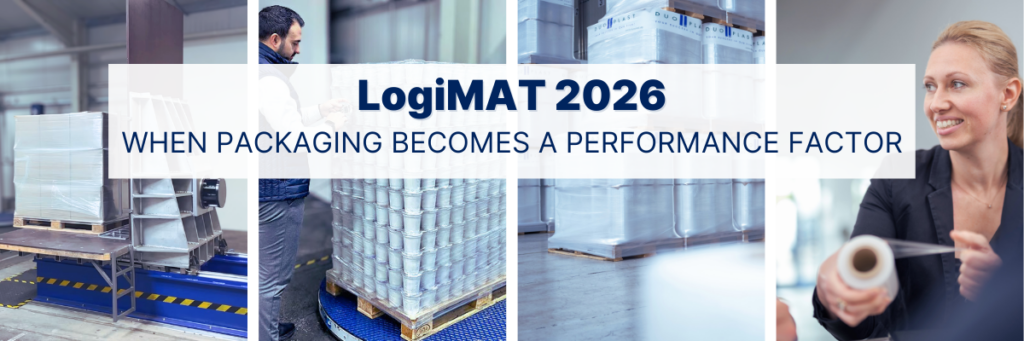
5 trends that will shape the beverage industry in 2026 – and what they mean for your load units.
The beverage industry will continue to face significant changes in 2026. Packaging is becoming lighter, processes faster, and regulatory requirements stricter. At the same time, the demand for reliable supply chains is increasing. This article presents the five most important trends and explains why load unit safety is becoming the key lever.
Less material, more stability, more reliability
The beverage market is developing dynamically: manufacturers are reducing material, increasing automation, and responding to sustainability pressure. At the same time, consumers expect high availability, quality, and convenience. Due to increasingly differentiated regulatory requirements of the EU Packaging Regulation, which will come into force gradually until 2030, the demands on sustainability and consumer protection are becoming even stricter.
The result: the requirements for stable load units are increasing significantly.
Bringing together material minimization, high PCR usage, and the efficient use of these resources is complex and requires investments in the supply chain, production processes, and the packaging itself. Transport packaging is not exempt from this — on the contrary: it is becoming the functional centerpiece of the entire value chain.

1. Lightweighting is changing the stability mechanics
Bottles, cartons, and outer packaging are becoming increasingly lighter in order to save CO₂ and material. Studies show that the European beverage packaging market is growing by more than 5% annually despite material savings (Mordor Intelligence, 2024).
But with every gram less, the robustness of the unit decreases.
The requirements for load unit safety are increasing, because similar premises apply here as in primary packaging:
- less material
- integration into material cycles
- reuse compatibility
- optional biological degradability (depending on the segment)
All of these requirements are in tension with the static and dynamic stability of the load unit. The industry thus faces the question: how can material reduction be combined with real transport durability?
2. End-of-line systems need consistent performance
The EU PPWR mandates recyclability, material efficiency, and high PCR content. Regardless of the technological maturity of the industry, it can be assumed that these requirements will — as announced (with few exceptions) — be fully implemented.
Especially in the polymer sector, stable recycling streams are the key to regulatory compliance. But high-quality PCR is:
- increasingly difficult to obtain in the long term
- still priced in the premium segment
- only limited in competitiveness with virgin-material products
- dependent on supplier markets that are consolidating heavily
For beverage manufacturers, this creates another area of tension:
Rising PCR requirements meet high EOL complexity – and the loading unit must function in both systems.
3. Sustainability & PPWR are shaping the future of packaging
Die EU-PPWR schreibt Recyclingfähigkeit, Materialeffizienz und hohe PCR-Anteile vor. Unabhängig vom technologischen Entwicklungsstand der Industrie ist davon auszugehen, dass diese Vorgaben – wie angekündigt (bis auf wenige Ausnahmen) – vollständig umgesetzt werden.
Gerade im Polymerbereich sind stabile Recyclingströme der Schlüssel zur Gesetzeskonformität. Doch hochwertiges PCR ist:
- perspektivisch schwer verfügbar
- preislich weiterhin im Premiumsegment
- nur begrenzt wettbewerbsfähig mit Neuware-Produkten
- abhängig von sich stark konsolidierenden Lieferantenmärkten
Für Getränkehersteller ergibt sich daraus ein weiteres Spannungsfeld:
Steigende PCR-Anforderungen treffen auf hohe EOL-Komplexität – und die Ladeeinheit muss in beiden Systemen funktionieren.
4. Product range diversity & complexity increase logistical requirements
The trend toward more SKUs — smaller batches, new flavors, seasonal editions, reduced-sugar variants, or functional beverages — is leading to significantly more complex logistics.
This has direct effects on the load units:
- changing pack sizes
- different weight distributions
- greater sorting and palletizing effort
- asymmetrical pallet patterns
- more frequent machine changeovers
The more heterogeneous the product range, the more demanding the securing of the load unit becomes.
Transport packaging today must operate adaptively, process-securely, and tolerant of packs with varying inherent stability.
5. Urban delivery & new logistics models increase dynamic forces
The transformation in retail — e-commerce, direct-to-consumer, urban delivery, smaller batch sizes — is leading to new transport profiles.
This results in additional burdens:
- more frequent stop-and-go movements
- more cycles in shorter intervals
- temperature changes
- vibration intensity in city logistics
- more frequent relocation processe
These factors increase the risk of:
- deformations of the entire load unit
- tilting of the pallet
- shifted layers
- damaged packs
- complaints from retailers
Transport safety thus becomes not only an operational issue, but also a qualitative and brand-strategic one.
Conclusion:
- Transport packaging solutions must become lighter, faster, and more sustainable at the same time.
- The importance of the stable load unit becomes more difficult to control due to the requirements.
- Packaging and process optimization are inseparably linked.
- Manufacturers who validate transport stability at an early stage reduce complaints, CO₂, and legal costs.
DUO PLAST supports beverage manufacturers in handling these requirements safely and efficiently – through laboratory tests in the in-house DUO LAB test center, EOL process analyses, stability-oriented consulting, and close support along the value chain.
At the center of this is not the film alone, but the entire load unit as a system.
(1) Mordor Intelligence (2024): Europe Beverage Packaging Market – CAGR +5,58 %
→ Wachstums- & Lightweighting-Trend / Primär- & Sekundärverpackungen
https://www.mordorintelligence.com/industry-reports/europe-beverage-packaging-market
(2) Grand View Research (2024): Beverage Packaging Market – Automatisierung & EOL-Wachstum
→ belegt High-Speed-End-of-Line & Maschinenabhängigkeit
https://www.grandviewresearch.com/industry-analysis/beverage-packaging-market
(3) EU-Kommission – Packaging and Packaging Waste Regulation (PPWR): Offizielle Beschreibung der Vorgaben (PCR, Recyclingfähigkeit, Materialreduktion)
https://environment.ec.europa.eu/topics/waste-and-recycling/packaging-waste_en
(4) ERP Recycling (2025) – PPWR Whitepaper: Detaillierte Umsetzung der PPWR, PCR-Pfade, regulatorische Timelines
https://erp-recycling.org/wp-content/uploads/2025/05/PPWR-Packaging-and-Packaging-Waste-Regulation-EN-final.pdf
(5) Plastics Recyclers Europe (2024): Marktdaten zu PCR-Verfügbarkeit & -Preisniveau (Premiumsegment)
https://www.plasticsrecyclers.eu